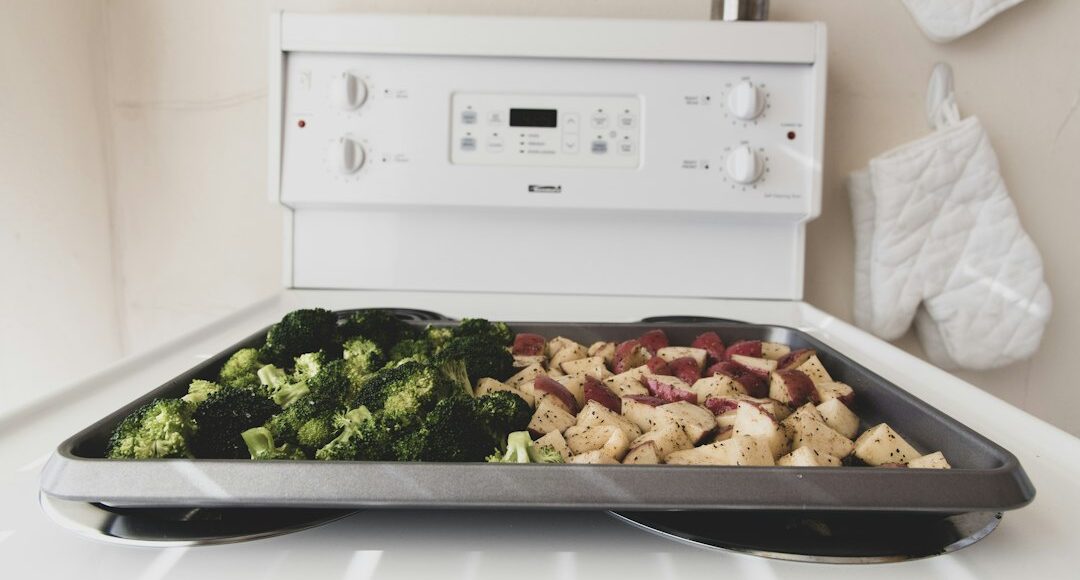
Why Sheet-Pan Vegetables Cook Unevenly: A Cut-Size and Start-Time Planner
Putting carrots, zucchini and mushrooms into the oven at the same time sounds convenient. Yet one vegetable can stay firm while another becomes limp. The issue is often not the recipe but the shape, water content and start time of each ingredient. This guide gives you a practical way to plan one tray without promising that every oven behaves alike.
One sheet pan, three different behaviors
| Vegetable | Typical preparation | Why timing differs |
|---|---|---|
| Carrot | Even, relatively small pieces | Dense pieces need more time to soften |
| Zucchini | Thicker half-moons | High moisture; small pieces can collapse quickly |
| Mushrooms | Halved or quartered evenly | Release moisture and shrink |
A flexible two-person tray
- Carrots: 200 g, trimmed and cut into evenly sized small pieces
- Zucchini: 200 g, cut into substantial half-moons
- Mushrooms: 150 g, cleaned and halved or quartered
- Olive oil: about 2 teaspoons total
- Optional herbs or lemon added at the end
Preheat an oven to around 200°C / 390°F and use a suitable oven-safe tray. This is an illustrative starting temperature, not an experimentally validated universal setting. Ovens differ; monitor the food and follow equipment instructions.
How to stagger without a complicated recipe
- Start with carrots. Spread them in a single layer with room for hot air to circulate. Roast for roughly 10–15 minutes before checking.
- Add the other vegetables. Turn the carrots and add zucchini and mushrooms without overcrowding. Return the tray to the oven.
- Assess instead of blindly waiting. Check every few minutes near the end. A fork should enter the carrot to your preferred tenderness; the zucchini should not be watery or disintegrating.
- Remove finished pieces. If one ingredient is ready first, transfer it with clean utensils and finish the others briefly.
- Record your real oven timing. Write down cut size, tray crowding, rack position and each addition time so your next batch is more predictable.
Total timing varies significantly with piece size, initial temperature, oven accuracy and tray material. The suggested sequence is a planning example rather than a guarantee of a 25- or 30-minute meal.
A two-tray decision rule
If you are cooking a large batch and vegetables are piled on top of each other, use another appropriately sized tray if your oven accommodates it. Crowding can trap moisture and shift the result toward steaming. Rotate positions safely as needed, following the oven’s instructions.
Mini worksheet
| Record | Batch example | Your result |
|---|---|---|
| Carrot cut size | Small, consistent chunks | _____ |
| Carrot head start | 10–15 minutes before others | _____ |
| Zucchini cut size | Thick half-moons | _____ |
| Tray condition | Single layer, some space | _____ |
| Finished texture | Tender carrot, intact zucchini | _____ |
Food safety and serving
Wash produce and use clean equipment. If you add raw meat or fish to the tray, their required safe cooking temperatures and cross-contamination prevention become separate issues; this vegetable-only example does not establish those foods are safely cooked. Refrigerate leftovers promptly using standard food-safety guidance.
FAQ
Why not cut everything extremely small?
Some vegetables will dry out or collapse before others have the desired flavor. Uniform pieces within each vegetable and staggered starts are usually more helpful than forcing identical dimensions across different vegetables.
Is browning the only sign of doneness?
No. Texture, moisture and the intended result matter. Use safe handling and taste only food that has been prepared appropriately.
Bottom line: Organize the pan by how vegetables cook, not simply by what is easiest to chop. For a wider kitchen workflow, see our cooking timeline planning guide.